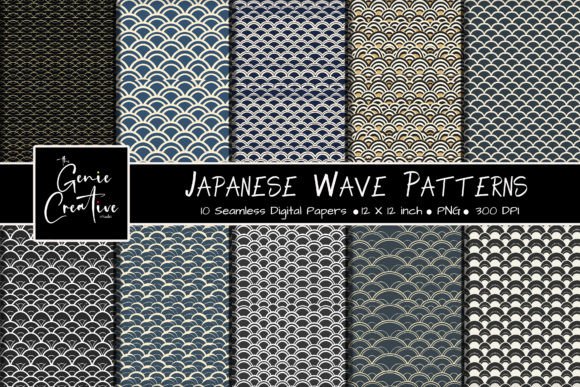
Japanese Wave Seamless Patterns Set: A Practical Guide for Designers and Makers
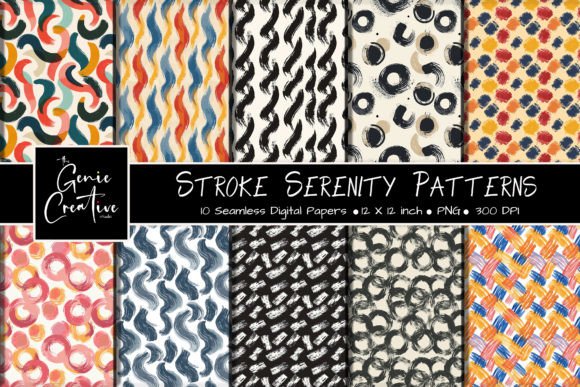
The Japanese Wave Seamless Patterns Set represents a specific category of digital assets designed to bridge traditional aesthetics with modern production workflows. At its core, this collection offers 10 seamless digital papers that capture the fluid motion of water or wind through stylized lines. Unlike static illustrations, these patterns are engineered to tile infinitely without visible breaks, making them essential for large-scale applications where continuity is critical. The distinct value proposition lies in the combination of cultural design language with technical specifications that meet professional printing standards.
When evaluating resources for creative projects, understanding the technical constraints of file formats is just as important as the visual appeal. This set provides files in PNG format at a resolution of 300 DPI, with dimensions of 12 x 12 inches. These specifications are not merely marketing points; they dictate exactly how the asset can be utilized in physical manufacturing versus digital display. For instance, a pattern intended for a t-shirt requires high pixel density to prevent blurriness during screen printing or direct-to-garment processes, while a wallpaper might prioritize vector scalability over raster resolution. The 300 DPI standard ensures that the Japanese Wave Seamless Patterns Set is immediately viable for commercial textile production without requiring upscaling software that often degrades image quality.
Evaluating Fit for Textile and Soft Goods Production
One of the primary use cases for this digital paper collection is in the realm of soft goods. The versatility of the wave motif makes it suitable for creating blankets, pillows, pajamas, clothes, and t-shirts. However, the decision to use a pre-made seamless set versus commissioning a custom illustration involves several tradeoffs regarding cost, time, and design uniqueness.
Strengths of using the set:
- Consistency: Because the images are seamless, repeating the pattern across a yard of fabric results in a uniform look. There are no "seams" or awkward transitions where the pattern repeats, which is a common issue when manually arranging non-seamless images.
- Speed: For designers working on tight deadlines, applying a ready-made Japanese Wave Seamless Patterns Set eliminates hours of vector tracing or manual pattern creation.
- Technical Readiness: The 12 x 12 inch size at 300 DPI is optimized for most print-on-demand services and home sewing projects. Users can scale the image down for phone cases or up for large banners without losing clarity.
Limitations and considerations:
While the set is robust, it may lack the specific color palette required for a brand's identity. If a project demands a specific shade of blue or a unique texture overlay, a generic set might require significant post-processing. Furthermore, because these are shared assets, there is a risk that other creators could produce similar products. For mass-market items like basic wrapping or simple paper goods, this is rarely an issue. However, for high-end fashion or exclusive branding, the ubiquity of the pattern could dilute the perceived exclusivity of the final product.
Digital Applications: Backgrounds, Wallpapers, and Paper Goods
Beyond textiles, the utility of the Japanese Wave Seamless Patterns Set extends into digital design and stationery. The clean lines and repetitive nature of the waves make them excellent candidates for website backgrounds, mobile wallpapers, and digital scrapbooking elements. In these contexts, the PNG format is particularly advantageous because it supports transparency. While the waves themselves are likely opaque, the ability to layer them over photographs or other graphic elements allows for complex compositions.
For wrapping and paper goods, the 300 DPI resolution ensures that the crispness of the wave lines remains intact even when printed on smaller scales, such as gift tags or business cards. When comparing this approach to purchasing physical paper rolls, the digital set offers a significant advantage in customization. You can print only the exact amount needed, reducing waste. Additionally, you have full control over the paper weight and finish, whereas pre-printed physical papers lock you into the manufacturer's choices.
However, users must consider the workflow differences. Creating a background for a website using a 12x12 inch image requires scaling logic. If the target screen resolution is significantly lower than the source file, the browser will handle the downscaling automatically, but the file size might be larger than necessary for web optimization. Conversely, for phone cases, the high resolution is a benefit, ensuring that the intricate details of the wave pattern do not pixelate on small, high-density screens.
Comparative Analysis: Seamless Sets vs. Custom Creation
A critical part of the decision-making process involves comparing the Japanese Wave Seamless Patterns Set against alternative approaches, such as creating patterns from scratch or sourcing vector graphics. Each method has distinct strengths depending on the project's scope.
Seamless Digital Papers (The Current Option):
This approach is best suited for users who need immediate results and possess intermediate skills in image editing software like Photoshop or GIMP. The tradeoff is less artistic control over the specific line weight or curve of the waves. It is ideal for hobbyists, small business owners launching a product line quickly, or educators looking for materials for workshops. The 10 variations within the set provide enough diversity to cover multiple projects without overwhelming the user with too many choices.
Custom Vector Illustration:
If the goal is a completely unique brand identity, hiring a designer to create a custom vector pattern is superior. Vectors allow for infinite scaling without any loss of quality, unlike the raster-based PNGs in this set. However, this option comes with higher costs and longer lead times. For a one-off pillow or a personal gift, the investment in custom work may not be justified. But for a clothing brand planning to manufacture thousands of units, the uniqueness factor often outweighs the initial expense.
Stock Photography and Textures:
Sometimes, designers opt for stock photos of water or textured paper to create a wave effect. While this can yield a more organic, realistic look, it often lacks the mathematical precision required for true seamless tiling. Achieving a perfect repeat with a photograph often requires advanced masking and cloning techniques that can introduce artifacts. The Japanese Wave Seamless Patterns Set removes this technical hurdle by providing mathematically perfect repeats out of the box.
Decision Factors: When to Choose This Set
To determine if the Japanese Wave Seamless Patterns Set is the right resource, evaluate your project against the following criteria:
- Volume of Production: Are you producing a single item or a batch? For batches involving blankets, fabric, or bulk wrapping, the efficiency of a seamless set is unmatched.
- Output Medium: Is the output primarily physical (printed) or digital? The 300 DPI specification confirms this set is optimized for physical printing. If the project is strictly for low-resolution social media thumbnails, a smaller file size would suffice, making this high-res set potentially overkill.
- Design Consistency: Do you need a cohesive look across different products? Using the same set for t-shirts, phone cases, and pillows ensures a unified aesthetic across your entire product line.
- Technical Skill Level: Are you comfortable manipulating layers and resizing images? If you are a beginner, starting with a pre-seamed asset reduces the learning curve associated with pattern creation.
There are scenarios where this set might not be the optimal choice. If your project requires a specific, highly detailed illustration that cannot be achieved with simple wave lines, or if you need a pattern that interacts dynamically with user input (such as a video game texture), a custom solution or a different asset type would be necessary. Additionally, if copyright exclusivity is a legal requirement for your business model, relying on a publicly available digital paper set poses a risk, as others may hold the rights to the same design.
Maximizing Value Through Creative Application
The true potential of the Japanese Wave Seamless Patterns Set is realized when it is applied creatively across diverse mediums. By leveraging the 10 unique variations, a creator can develop a comprehensive brand identity. For example, one variation could serve as the background for a website, another for the lining of a jacket, and a third for the packaging of a related product. The consistency in style unifies the experience, even if the specific wave pattern changes.
Furthermore, the high-quality 300 DPI resolution allows for experimentation with different printing techniques. You might test the pattern on glossy photo paper for posters, matte cardstock for invitations, or synthetic fabrics for durable outdoor gear. The flexibility of the PNG format means you can easily adjust opacity or blend modes in editing software to adapt the pattern to different lighting conditions or material textures before sending it to the printer.
In conclusion, the Japanese Wave Seamless Patterns Set serves as a practical, high-fidelity tool for makers and designers. It balances the need for aesthetic appeal with the rigorous demands of production. While it may not offer the bespoke uniqueness of a commissioned artwork, its reliability, technical specifications, and ease of use make it a superior choice for a wide range of applications, from crafting personalized gifts to launching a commercial product line. By understanding its strengths and limitations, users can effectively integrate these digital papers into their workflow to achieve professional results efficiently.